By siddiquaseo
 You’ve probably used both at some point and formed a preference. But your preference may be based on casual wear experience, not on what actually performs better under your specific training conditions.
The cut of your workout underwear affects performance in ways most men haven’t mapped to their actual training.
What Most Men Get Wrong About Underwear Cut for Exercise
The assumption most men carry into this decision: the cut that’s comfortable for everyday wear is the cut that’s comfortable for exercise. This isn’t reliable reasoning. The biomechanics of exercise — stride length, hip mobility, squat depth, leg swing — create demands that everyday wear doesn’t test.
The wrong cut leads to: fabric bunching at the inner thigh, riding up during hip flexion, restricted range of motion in full squats, or excessive fabric movement that creates friction. All of these are cut problems, not fabric problems. And they often get attributed to the wrong cause — “workout underwear just doesn’t stay in place” — when the actual issue is that the cut doesn’t match the movement pattern.
The best workout underwear cut depends on what you’re training, not on what you wear on rest days. These are different optimization problems.
The Cut Comparison
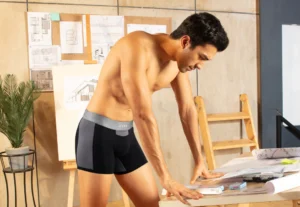
Boxer Briefs
Leg length: Typically 3 to 5 inches below the hip. Covers the upper thigh. Inner thigh coverage: Complete. The extended leg length creates a fabric barrier across the entire inner-thigh zone. Range of motion: Good, with adequate elastane content. The longer cut stays against the thigh through hip flexion rather than riding up. Best for: Running, cycling, HIIT with extensive leg movement, any activity with repetitive thigh-to-thigh contact. Chafing profile: Low. Continuous thigh coverage eliminates the primary inner-thigh chafing zone for cardio athletes. Organic cotton option: Organic cotton boxer briefs with 5% elastane deliver the thigh coverage advantage with natural fiber softness.
Trunks
Leg length: Typically 1 to 3 inches below the hip. Minimal thigh coverage. Inner thigh coverage: Limited to minimal. The leg opening ends at or near the groin crease. Range of motion: Excellent at the hip. Less fabric means less restriction for pure hip mobility. Best for: Weightlifting, lower-body resistance training, any activity where hip mobility is the priority and thigh contact is minimal. Chafing profile: Higher for cardio. The leg opening edge becomes a friction point during thigh-to-thigh movement. Organic cotton option: Organic cotton boxer briefs style underwear in a trunk cut applies the same material principles with the shorter cut for mobility-focused training.
Matching Cut to Training Modality
| Activity | Recommended Cut | Key Reason |
|---|---|---|
| Running / cycling | Boxer briefs | Inner-thigh chafing prevention |
| Weightlifting / CrossFit | Trunks | Hip mobility priority |
| Team sports / HIIT | Boxer briefs | Varied movement planes, thigh contact |
| Swimming / water sports | Either | Worn under training shorts, fit preference |
What Matters Beyond Cut
Cut is the first variable to optimize. Once you’ve identified the right cut for your primary training, the material variables that determine performance within that cut become the deciding factors:
Elastane percentage. For boxer briefs, 5% elastane allows the extended leg cut to move with the body without restricting hip flexion. Too little elastane and the leg hem creates a tourniquet effect during lunges or sprints. Too much and you’re in compression territory with significantly higher synthetic content.
Waistband construction. A waistband with a cotton inlay — rather than bare elastic touching the skin — sits more comfortably under the range-of-motion demands of exercise. Bare elastic can imprint and irritate during extended sessions.
Seam placement in the inner leg. Flat seams or minimal-seam construction in the inner leg zone reduces friction from seam ridges during thigh-to-thigh contact movements. For boxer briefs specifically, this is worth examining before buying.
Natural fiber softness across cut-specific friction zones. The fabric properties that prevent chafing and maintain comfort through extended wear apply differently across cuts. For boxer briefs, the inner thigh fabric surface is the critical zone. For trunks, the leg opening edge is the friction point.
The Practical Decision
For most men who train across modalities, boxer briefs are the default correct choice. They outperform on chafing prevention for cardio, they’re adequate for strength work with sufficient elastane, and they eliminate the leg-opening edge friction issue that affects trunks during high-motion activities.
If you do primarily heavy strength work — deadlifts, squats, Olympic lifting — and relatively little cardio, trunks offer the hip mobility advantage with less unnecessary fabric.
The ideal solution for men who do both: a rotation with both cuts, used for their specific contexts. Boxer briefs for training days involving significant cardio or lateral movement. Trunks for pure strength sessions. Both in organic cotton for the health benefits that apply equally regardless of cut.